

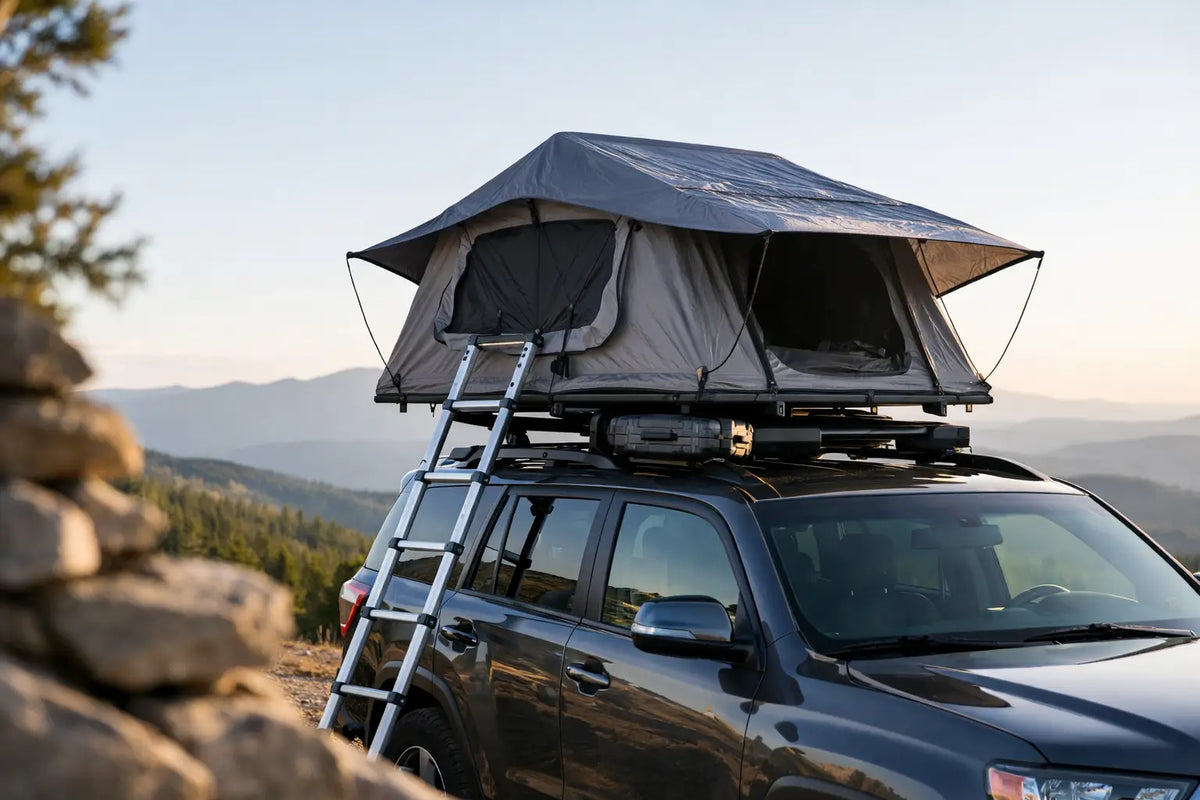
A rooftop tent can turn a Friday evening into a proper escape. But before you trade streetlights for a trailhead, get the roof load limit for rooftop tent setups right. This is not a detail to guess at, or a number to borrow from somebody else’s build. It is the foundation of a safe, stable and comfortable night above the ground.
The good news: you do not need to be an engineer to make a sound decision. You do need to understand which weight rating applies when, how your rack system changes the equation, and why a tent’s sleeping capacity is not the same thing as its weight on the move.
Roof load limit for rooftop tent setups: start with dynamic load
The number that matters most while driving is your vehicle’s dynamic roof load rating. This is the maximum weight the vehicle roof is designed to carry while the vehicle is in motion. It accounts for braking, cornering, potholes, crosswinds and the constant vibration of real roads.
You will usually find this figure in the owner’s manual, vehicle manufacturer documentation or through a dealer. Do not confuse it with the static roof load rating. Dynamic capacity is commonly lower, and it is the limit your complete rooftop system must stay within on the road.
That complete system includes the rooftop tent, mounting hardware, crossbars or platform rack, any awning brackets, recovery boards, storage boxes and other gear fixed above the roofline. If your vehicle has a 75 kg dynamic roof rating, for example, a 60 kg tent may leave very little room once the rack and fittings are included.
The lowest rating always wins. Your setup is limited by the lowest-rated part of the chain: the vehicle roof, roof rails, crossbars, rack platform, tent mounts or associated brackets. A heavy-duty rack does not increase the vehicle manufacturer’s roof rating. It simply needs to be capable of carrying its share safely.
Static load is different - and it matters at camp
Once parked, the forces acting on the roof change. You are no longer hitting uneven tarmac at speed, so the system can typically support more weight while stationary. This is known as static load capacity.
That is why a properly matched rooftop tent system can often support the tent plus its occupants at camp even though the vehicle’s dynamic roof rating seems much lower. The load is spread through the rack, rails and vehicle structure rather than being repeatedly shocked by motion.
Still, do not treat static capacity as a licence to overload the roof. Vehicle manufacturers do not always publish a static figure, and rack brands may use different testing methods. There is no universal rule that lets you multiply a dynamic rating by a set number and call the result safe. Follow the guidance for your vehicle, rack and tent, and use the most conservative compatible rating where information is unclear.
Static load is also about how you camp. A tent set up on level ground behaves very differently from one pitched on a steep side slope in gusty weather, with people climbing in and out repeatedly. Comfort starts with stability.
Do not confuse roof rails with a roof rack
Factory roof rails can look ready for adventure, but they are not automatically suitable for a rooftop tent. Many are intended for light cargo carriers, bikes or occasional roof boxes. Their shape, mounting points and stated load capacity may not support the concentrated loads created by a tent platform.
A vehicle-specific rack or crossbar system is often the smarter route. The right system spreads weight across approved mounting points and gives the tent a secure, level base. It also reduces flex, noise and the chance of damaging roof trim or rails over time.
Pay attention to the distinction between raised rails, flush rails, fixed points, rain gutters and bare-roof mounting systems. They require different hardware. A universal-looking clamp is not a substitute for a rack designed for your vehicle.
If you drive an SUV, estate car, pickup or 4x4, do not assume that a larger vehicle has a higher roof rating. Some compact vehicles have strong roof structures, while certain larger models have modest dynamic limits. Check the actual specification for your exact model year and roof configuration.
Work out your real travelling weight
The easiest way to avoid a costly mismatch is to calculate your total roof weight before buying or fitting anything. Use the stated weights for every component, not just the tent.
Add the tent, rack or crossbars, mounting rails and brackets, awning or awning mounts, and any permanent gear carried on the roof. Use the installed weight rather than a stripped-back product weight wherever possible. If a product specification does not make clear what is included, allow a sensible margin until you can confirm it.
A lightweight hard-shell tent can be an excellent fit for vehicles with tighter roof ratings, particularly when it pairs fast setup with a low profile on the road. A larger tent may offer extra room for family trips, but its weight and footprint demand a more capable vehicle and rack system. Neither choice is universally better. The right choice fits your vehicle, your passengers and the way you actually travel.
Remember that roof weight is only one part of overall payload planning. People, luggage, water, food, recovery equipment and towing nose weight can all count towards the vehicle’s gross vehicle weight rating. A roof setup that is within its own limit can still contribute to an overloaded vehicle if the rest of the trip has been packed without care.
Fitment is where confidence is built
A quality rooftop tent deserves a careful installation. Fit the rack exactly as its manufacturer specifies, use the correct mounting kit, and ensure the tent sits squarely on the crossbars or platform. Bar spacing matters. So does the direction of the tent opening, especially if an awning, hatch or rear door needs clearance.
Tighten mounts to the specified torque. Over-tightening can damage hardware or roof rails; under-tightening allows movement that can wear mounting points and create noise. After the first drive, recheck every fixing. Then make inspections part of your routine, especially after rough tracks, long motorway runs or a season stored outdoors.
Look for loose bolts, worn straps, cracked plastic trim, corrosion, rack movement and any signs that a crossbar is deforming. A small issue is far easier to solve at home than at a remote campsite after dark.
Driving changes when the roof is loaded
Even a well-matched tent changes your vehicle. The extra height can affect access to car parks, garages, ferry decks and drive-throughs. The added mass up high raises the centre of gravity, which can make the vehicle feel less settled in quick turns and stronger crosswinds.
Drive accordingly. Leave more braking distance, take bends smoothly and slow down on rough surfaces. Follow the tent and rack manufacturers’ speed guidance rather than assuming the speed limit is automatically appropriate for a loaded roof. Wind noise and fuel use may increase too, particularly with a taller setup. That is the trade-off for taking a proper sleeping space wherever the road leads.
Before every departure, close and latch the tent fully, secure its cover or shell, stow the ladder, and check that no fabric, straps or bedding can catch the wind. This takes minutes and protects the gear that makes spontaneous nights away possible.
When to ask for expert help
If your vehicle manual is vague, your roof rails have no visible rating, or you are combining a tent with an awning and other roof-mounted equipment, pause before fitting it. Ask the vehicle manufacturer, rack supplier or a qualified installer for model-specific guidance. A clear answer is worth far more than forcing a setup that only almost works.
Urban Caveman is built around making life beyond the city feel less complicated, not adding doubt to the driveway. The best rooftop tent setup is not necessarily the biggest one. It is the one that sits securely on your vehicle, sets up quickly at camp and lets you sleep well knowing the system beneath you has been chosen with care.
The road out of town should feel like freedom, not a physics experiment. Check the ratings, respect the limits and build the setup that gives you confidence to take the longer route home.
Share:
Are Roof Tents Worth It? Elevating Your British Camping Experience in 2026
Small Car Rooftop Tent Compatibility Explained