

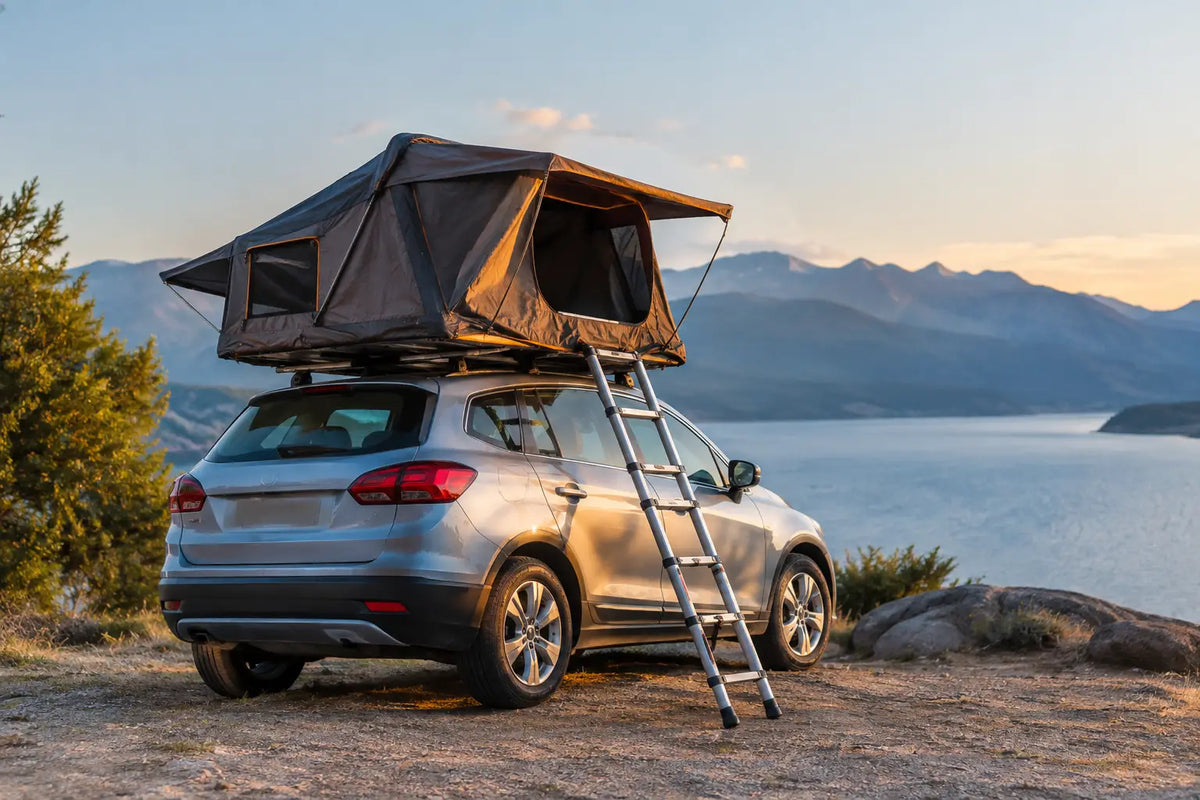
A hatchback parked beside a lake with a rooftop tent above it makes a convincing case for leaving the city on Friday night. But can hatchbacks carry roof tents safely? Often, yes. The answer depends less on the size of the car than on the roof’s dynamic weight limit, the rack system beneath the tent, and whether the whole setup is properly matched.
Small car. Bigger horizon. The right combination can turn a practical daily driver into a capable weekend basecamp without pretending it is something it is not.
Can Hatchbacks Carry Roof Tents Safely?
Many hatchbacks can carry a rooftop tent, provided the tent, roof bars and vehicle roof are all within the manufacturer’s stated limits. There is no universal rule that says a hatchback is too small. Some compact cars have roof load limits and mounting points that suit lighter rooftop tents very well; others do not.
The number that matters first is the dynamic roof load limit. This is the maximum weight your car’s roof can carry while you are driving. It must cover everything on top: the roof bars or platform, tent, mounting hardware, and any accessories stored on the roof.
Do not confuse this with the static roof load limit. Static capacity is what the vehicle can support while parked, when the tent is open and people are sleeping inside. It is usually much higher because the load is spread through the roof structure and the vehicle is not coping with braking, cornering, potholes or motorway wind pressure.
A car with a 75kg dynamic roof rating may be able to support far more than 75kg when stationary. That does not mean you can fit a 75kg tent to it. Once you add 8-15kg of bars and fittings, you have already exceeded the driving limit.
Start With the Numbers, Not the Tent
Before choosing a tent based on its look, mattress or sleeping capacity, find your hatchback’s approved roof load figure. Check the owner’s handbook, speak to the manufacturer or ask a vehicle dealer to confirm it using your registration or VIN. Do not rely on forum posts, social media clips or the weight rating of a roof bar alone.
Then calculate the complete travelling load. For example, a 52kg hard-shell tent paired with 10kg of roof bars creates a 62kg roof load before you add crossbar locks, brackets or a ladder. On a hatchback rated to 75kg, that may leave a sensible margin. On a car rated to 50kg, it is not an appropriate fit.
Roof bars also need their own rating. They must be designed for your exact vehicle, correctly installed and rated to carry the load you intend to place on them. A pair of generic bars that fits physically is not necessarily a safe foundation for a rooftop tent. Vehicle-specific fitting kits matter because they distribute load through approved fixing points.
If your roof has flush rails, raised rails, fixed points or a bare roof, the compatible rack options will differ. Never mount a rooftop tent directly onto decorative roof rails or crossbars that have not been approved for that purpose.
The Hatchback Trade-Off: Weight, Space and Stability
A hatchback is not automatically a compromise. It can be the smarter adventure vehicle for solo travellers and couples who value lower running costs, easy parking and the freedom to leave town without driving a large 4x4 every day.
The trade-off is roof capacity. Larger estates, SUVs and pickups often have higher dynamic roof limits, which gives them more choice in wide, heavy hard-shell tents and large accessories. Hatchbacks generally reward a lighter, more compact setup.
That can work in your favour. A lighter tent puts less weight above the car, preserves more of the vehicle’s natural handling and is easier to live with between trips. It also keeps the overall profile cleaner, which matters when you are navigating multi-storey car parks, low branches and the usual height barriers near popular UK trailheads.
The car’s footprint matters too. A tent may extend beyond the roofline when open, and that is normal, but check how the ladder lands and where doors can open. You want enough room to set up safely on uneven ground without blocking access to the boot or stepping into a puddle every time you climb down.
Choose a Tent That Fits the Vehicle and the Way You Travel
For most hatchback owners, a compact soft-shell or lightweight hard-shell model is the practical starting point. The best option is not always the lightest one, though. A tent should suit the number of sleepers, the weather you expect and how quickly you want camp to be ready.
Hard-shell tents tend to offer a fast, tidy setup and a lower profile when closed. They suit drivers who want to arrive after work, park up and be settled before the light disappears. Their fixed shells can add weight, so careful checking is essential on smaller cars.
Soft-shell tents can provide generous sleeping space for their packed weight and may be a strong match for hatchbacks with modest roof ratings. They often take a little longer to open, particularly if you are adding an annex or managing a cover in wet weather. For longer stays, that extra room may be worth it.
Think beyond the tent itself. An awning, roof box, recovery boards and other rooftop kit all affect the same dynamic load limit. If comfort is the goal, it is often better to choose a tent that leaves capacity for a solid rack system than to force the heaviest possible tent onto the roof.
Driving With a Roof Tent on a Hatchback
A correctly fitted rooftop tent changes how any car feels on the road. On a hatchback, the effect can be more noticeable because the tent sits high relative to the vehicle’s overall weight and width.
Expect more wind noise, increased fuel consumption and greater sensitivity to crosswinds. Give yourself extra braking distance, take corners smoothly and slow down in poor weather. Avoid treating the car as if nothing has changed simply because the tent is neatly folded away.
Height is the detail that catches people out. Measure the full vehicle from the ground to the highest point of the closed tent, then keep that figure somewhere visible. Low car park entrances, drive-throughs, ferry decks, tree-lined lanes and height barriers are less forgiving than an open campsite.
Check the tent mounts and roof bars regularly, particularly after the first long journey and after rough roads. Fasteners can settle, and road vibration is relentless. Follow the torque guidance from the rack and tent manufacturers rather than overtightening bolts in the hope that more force means more security.
Sleeping Up Top: Static Load, Levelling and Common Sense
Once parked, a suitable hatchback-and-tent setup can be an impressively comfortable place to sleep. The tent’s base, roof bars and vehicle roof work together to carry the static load, not just a single point on the roof. That is why a parked vehicle can safely hold sleeping occupants despite a much lower dynamic driving rating.
Still, use common sense. Park on stable ground, apply the handbrake, avoid steep side slopes and set the ladder at the recommended angle. If your tent design requires it, use the ladder as a structural support exactly as instructed. Do not improvise with blocks, loose stones or an overextended ladder.
Wind deserves respect too. A rooftop tent is designed for outdoor use, but exposed coastal pitches and high ridgelines can turn a comfortable night into a noisy one. Choose a sheltered pitch where possible, secure every cover and strap, and pack the tent dry when you can. If rain forces a wet pack-down, open it to air as soon as you are home.
When a Hatchback Is Not the Right Match
There are times to choose another route. If your car’s dynamic roof limit is below the combined weight of a suitable tent and rack system, stop there. Do not assume static capacity makes up for it, and do not let a tempting deal override the manufacturer’s figures.
A hatchback may also be a poor fit if you regularly travel with three or four adults, need a large family tent, or want to carry substantial roof-mounted equipment alongside your sleeping setup. In those cases, a larger vehicle or a ground-based camping system may deliver more comfort with fewer compromises.
The point is not to make every car do every job. It is to build a setup that feels composed on the motorway, quick at camp and genuinely enjoyable when the weather turns.
Your hatchback does not need to become an expedition rig to earn its place outdoors. Match the tent to the ratings, fit it with the right rack system, and a familiar city car can be ready for quieter roads, colder mornings and a better view when you wake up.
Share:
Roof Tent Security for Confident Nights Away
How to Pack a Roof Tent Without the Struggle