

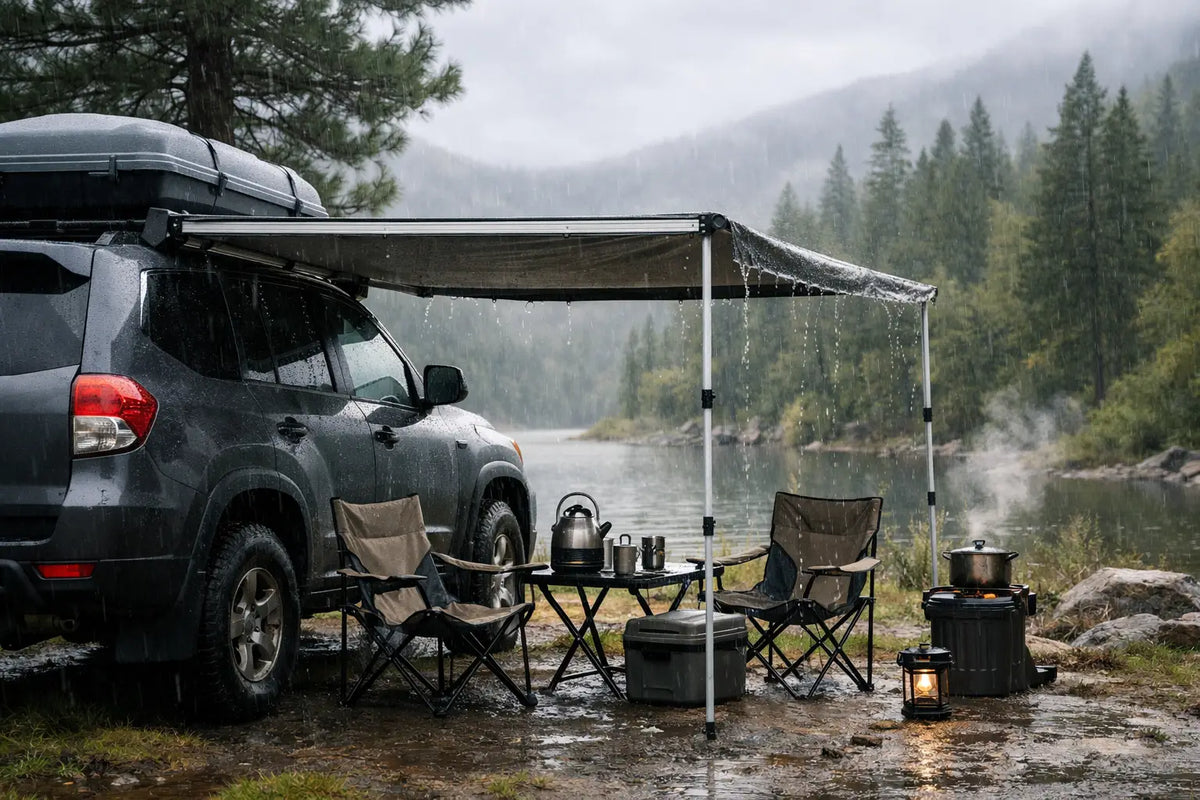
Rain has a habit of arriving just as the kettle goes on. A car awning for rain turns that moment from a retreat into part of the trip: a dry place to cook, sit, sort wet boots and enjoy the view without hiding inside the vehicle. For UK road trips, that is not a luxury. It is the difference between a campsite that works and one you pack down early.
A good awning gives your vehicle a proper outdoor room in minutes. But not every shade awning is built to manage wind-driven showers, saturated ground or a long evening of steady rain. The right choice comes down to the fabric, the frame, the shape and how you plan to use your vehicle.
What a car awning for rain needs to do
The first job is simple: keep water above you, not running through your camp. The second is more demanding. It must shed rain away from the vehicle, stay stable when the weather shifts and leave enough usable space beneath it for real camp life.
Waterproof fabric is only one part of that equation. A large flat canopy can collect water if it is pitched level, regardless of how high its waterproof rating is. Once a pool forms, weight builds quickly. The fabric sags, the legs are put under strain and your dry space becomes a problem to solve.
Look for an awning that can be angled down from the vehicle, creating a clear route for runoff. This small adjustment matters more than most people expect. On a wet Welsh weekend or a coastal stop where rain arrives sideways, a steep pitch helps water leave the canopy before it can gather.
Coverage matters too. A narrow strip of shelter is useful for grabbing kit from the boot, but it will not comfortably protect a table, two chairs and the person making dinner. Think about your actual routine. Couples often want enough room for cooking and relaxing. Families may need space for muddy children, a dog bed and bags that cannot go inside the rooftop tent. Bigger is better only if your vehicle, pitch and setup style can support it.
Fabric ratings are useful, but not the whole story
Awning materials are usually described with a hydrostatic head rating, measured in millimetres. In basic terms, a higher figure indicates greater resistance to water pushing through the fabric. It is a helpful comparison point, especially for persistent rain, but it should not be the only number guiding your decision.
The quality of the coating, the condition of the seams and the way the awning is pitched all have a direct effect on weather performance. Taped seams are particularly valuable because stitched needle holes can otherwise create weak points where water finds its way through. A weatherproof storage bag also earns its place. Packing a wet awning away is sometimes unavoidable, but a bag that contains moisture protects the rest of your setup until you can dry it properly at home.
Material weight presents a trade-off. Heavier fabrics generally feel more substantial and can offer better long-term confidence in difficult weather. They also add load to the roof and can be less convenient to handle. Lighter awnings are easier to deploy and suit drivers who value fast overnight stops, though they need careful pitching when conditions turn rough.
For most British vehicle campers, choose proven waterproof construction rather than chasing the biggest number on a spec sheet. A well-made, correctly tensioned awning will outperform an impressive rating on a poorly designed canopy.
Choose the shape around your camp life
Straight pull-out awnings are the quick, clean option. They create an immediate sheltered strip along the side of the vehicle and work well for coffee stops, lunch breaks and compact camps. Their simplicity is their strength: release the cover, extend the canopy, set the legs and get on with the evening.
Freestanding or wraparound designs offer more coverage, often reaching around the rear of the vehicle. They create a far more generous living area and can make a rooftop-tent camp feel remarkably complete. The trade-off is setup time, pack size and the need for secure guying. In calm weather, they feel expansive. In strong gusts, every pole, peg and strap needs attention.
An awning room or side wall can make a major difference in rain. It blocks the low, wind-driven weather that slips under an open canopy and gives you privacy for changing clothes or storing gear. It also reduces the usable open space, so it is worth deciding whether you want an airy day shelter, a protected room or a flexible system that can become either.
For a weekend escape, speed may be the priority. For longer off-grid trips, modular shelter starts to make more sense. There is no universal best option. The strongest setup is the one you will actually use, even when you arrive tired after a long drive.
Mounting is where confidence begins
Your awning is only as secure as its mounting system. Before buying, confirm that your roof bars or roof rack can carry the awning’s weight and that the mounting brackets are compatible with their profile. Do not assume universal means perfect. Bar spacing, clearance around a rooftop tent and access to the boot or tailgate can all affect where the awning sits.
Position is practical, not just visual. Side mounting is usually ideal for creating a living area beside the vehicle, while a rear-mounted solution can be useful for shelter over a tailgate kitchen. Check which doors need to open beneath the canopy and whether the awning will interfere with a rooftop tent ladder.
It is also worth considering vehicle height. An awning mounted high on a 4x4 provides useful headroom but can be harder to reach during setup. A compact step stool may be the sensible addition that keeps the process effortless. The aim is not to build a complicated camp system. It is to make dry shelter available before the first proper shower arrives.
Pitch it for the weather, not the photo
An awning looks best when it is wide, high and perfectly square. Rain does not care. For wet conditions, pitch one outer corner lower than the mounting edge, or lower one side enough to form a deliberate drainage channel. Keep the exit route away from your doorway, cooking spot and chair line.
Use guy lines whenever there is wind, not only when the forecast looks dramatic. Wind load can turn a canopy into a sail in seconds, especially on exposed sites. Peg the legs down where possible, tension the lines evenly and check them again after the fabric has settled. On hardstanding, use suitable weighted anchors or move to a position where the awning can be properly secured.
Avoid leaving any awning open unattended. Weather in the UK can shift from still to gusty in the time it takes to walk to the campsite tap. If you are heading out for a hike, pack it away. It takes less time than repairing bent poles, damaged fabric or a scratched vehicle.
Small habits that keep rain outside
A dry camp is built from details. Keep the canopy free of leaves and pooled water, especially overnight. Wipe mud from telescopic legs before collapsing them, as grit can affect adjustment mechanisms over time. When you return home, open the awning fully and let it dry before storing it. Even premium fabric needs this care to avoid mildew, odour and coating damage.
Think about the ground beneath your shelter as well. If runoff is flowing towards the vehicle, reposition the lower edge or adjust your pitch. Put cooking kit on a stable table rather than the ground, and keep bedding, electrics and clothing in sealed storage. The awning should create a working outdoor space, not a damp holding area for everything you own.
A pair of side walls, a durable ground mat and a simple folding table can turn the protected footprint into a proper camp kitchen and lounge. That is where a quality awning earns its place. It does not just block rain. It gives the whole trip room to breathe.
Build a camp you want to stay in
The best vehicle setups make poor weather feel manageable rather than miserable. A car awning for rain should deploy quickly, drain cleanly and stay composed when the forecast has other ideas. It should fit your vehicle without compromise and offer enough cover for the people and routines that make your trips worth taking.
Urban Caveman builds for that kind of freedom: refined comfort when the city is behind you, dependable shelter when the clouds roll in. Choose your awning with the same intention you choose your destination. Then when rain taps on the canopy, put the kettle on and stay exactly where you are.
Share:
Is a Rooftop Tent Annex for Families Worth It?
What Does Rooftop Tent Warranty Cover, Really?