

Your vehicle's roof is far stronger than you've been led to believe, yet a single miscalculation could turn a premium expedition into a costly structural repair. Understanding your roof tent weight limit isn't just about safety; it's about unlocking the true potential of your 2026 overlanding setup. It's natural to feel a sense of hesitation when mounting a heavy hardshell tent for the first time. You want the elevation and the views, but the fear of damaging your vehicle's frame or choosing the wrong rack system is a common hurdle for the modern nomad.
We're here to bridge the gap between engineering precision and the raw call of the wild. You'll master the technicalities of vehicle roof capacities to ensure your next wilderness expedition is as safe as it is sophisticated. We'll explore the critical distinction between dynamic and static loads, break down the latest ISO 11154:2023 safety standards, and show you how to calculate your setup's total weight with absolute certainty. From lightweight hardshells to robust family options, you'll gain the clarity needed to invest in premium gear that performs without compromise whilst you explore the British countryside.
Key Takeaways
- Master the vital distinction between dynamic and static loads to safeguard your vehicle's frame whilst exploring the wild.
- Learn the precise method to calculate your roof tent weight limit by identifying the lowest capacity amongst your roof, rack, and hardware.
- Understand how smaller vehicles like hatchbacks and estates can be safely equipped for elevated camping without compromising performance.
- Discover why high-quality hardshell tents are the premier choice for maintaining stability and durability in varied British weather conditions.
- Gain the technical assurance needed to transition from urban settings to remote wilderness with a secure and sophisticated mounting system.
Understanding Roof Tent Weight Limits: Engineering Peace of Mind
Engineering a seamless transition from the structured lines of the city to the untamed beauty of natural landscapes begins with a single, critical calculation. Your roof tent weight limit is the silent architect of every successful expedition. It isn't merely a restrictive number found in a manual; it's the technical threshold that ensures your vehicle remains a sanctuary of safety and style. When you respect these engineering parameters, you aren't just following rules. You're preserving the structural integrity of your vehicle's pillars and ensuring that your journey remains as refined as the gear you've chosen.
A premium roof rack system provides the essential interface between your vehicle and the wild, but even the most robust hardware cannot override the laws of physics. Precision loading is about more than just fitting gear. It's about maintaining the sophisticated balance that high-end vehicles are designed to provide. By understanding the limits of your vehicle's frame, you create a foundation for exploration that's both rugged and reliable.
The Consequences of Overloading
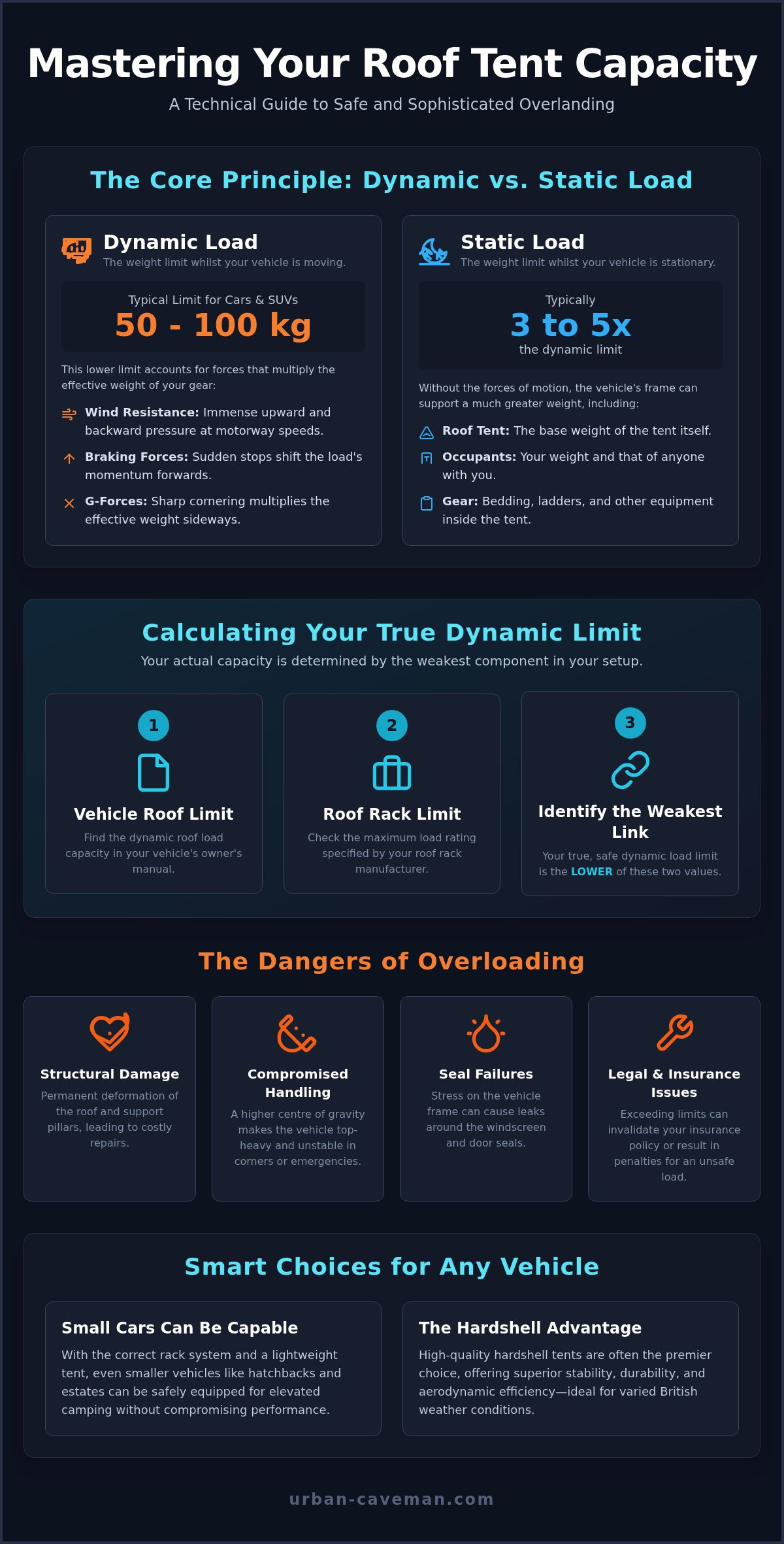
Neglecting these limits carries tangible risks that go beyond a simple dent. Overloading can lead to seal failures around the windscreen or permanent deformation of the roof's support structure. Perhaps more critically, excess weight significantly raises your vehicle's centre of gravity. This shift alters how your car behaves during emergency manoeuvres or whilst navigating high-speed corners on the motorway. Currently, these technicalities carry legal weight. Exceeding manufacturer-specified limits can invalidate your insurance policy or result in penalties if your vehicle is deemed to be carrying a dangerous load. Safety isn't an optional extra; it's the core of a sophisticated adventure.
The Philosophy of Lightweight Exploration
True luxury in the wild is found in effortless utility. At Urban Caveman, we believe that physical strength shouldn't come at the expense of aesthetic elegance. A lighter, more considered setup allows for a more fluid transition between diverse terrains, from coastal tracks to mountain passes. By choosing tents crafted from high-end, durable materials, you reduce the strain on your vehicle without sacrificing comfort. Our curated range focuses on this harmony, providing a rooftop sanctuary that feels like a natural extension of your vehicle's design. It's about being prepared for the unpredictable wild whilst maintaining the polished sensibility of modern exploration. Mastering your roof tent weight limit ensures that your focus remains on the horizon, not on the equipment above your head.
Dynamic vs Static Load: The Essential Definitions
To master the technicalities of your setup, you must first distinguish between two vastly different engineering figures. The roof tent weight limit isn't a single static number. It's a dual-layered specification that accounts for the extreme forces of a vehicle in motion versus the steady support required whilst you sleep under the stars. Automotive manufacturers provide these ratings to ensure your vehicle handles predictably on the motorway and remains structurally sound when stationary. This distinction is the foundation of a safe, sophisticated overlanding experience.
Dynamic Load: Precision in Motion
Dynamic load is the maximum permissible weight for a vehicle travelling at highway speeds. For most passenger cars and SUVs in the UK, this figure typically ranges between 50kg and 100kg. This limit is significantly lower than the static capacity because it accounts for the violent kinetic energy generated whilst driving. Wind resistance at 70mph exerts immense upward and backward pressure on your tent, whilst emergency braking or sharp cornering multiplies the effective weight of the load through G-forces. If you exceed this limit, you risk compromising the vehicle's centre of gravity, leading to unpredictable handling that feels top-heavy and unstable. If you're looking for a setup that balances weight and durability, our range of premium hardshell roof tents is engineered for aerodynamic efficiency and reduced drag.
Static Load: Your Rooftop Sanctuary
Once you've found the perfect wild camping spot and the engine is off, the physics of your roof change entirely. Static load refers to the weight your vehicle can support when it's stationary. Because the vehicle isn't contending with wind or braking forces, the capacity is dramatically higher, often three to five times the dynamic limit. This allows your roof to support the tent, the rack, and the combined weight of two or three adults without issue. Modern vehicles are built to exacting vehicle safety standards for roof strength, designed to protect occupants in the event of a rollover. These reinforced pillars and internal structures act as a high-strength frame, distributing the weight of your rooftop sanctuary across the car's strongest points. You don't need to fear the weight of your family whilst parked; the car's structural cage is designed for far greater stress than a peaceful night's sleep. Understanding your roof tent weight limit in these two distinct contexts allows you to choose gear with confidence, knowing you're within the safe operating parameters of your vehicle's design.
How to Calculate Your Vehicle’s Total Roof Capacity
Precision is the hallmark of a premium setup. You cannot afford to guess when mounting a high-end sanctuary atop your vehicle. Calculating your total capacity is a methodical process that requires you to look beyond a single number. It involves understanding the synergy between your vehicle's frame, your mounting hardware, and the tent itself. To achieve a safe and sophisticated configuration, you must identify the "weakest link" in your system. This is the lowest weight rating amongst all your components. If your vehicle's roof is rated for 75kg but your roof bars are only rated for 60kg, your actual roof tent weight limit is 60kg. Ignoring this hierarchy risks structural failure whilst you're on the move.
The System Weight Formula
To find your total dynamic load, you must account for every gram added to the roofline. Use this simple yet vital calculation: Tent Weight + Roof Rack Weight + Accessory Weight = Total System Weight. This final figure must remain below the dynamic limit specified by your vehicle manufacturer. For example, if you've chosen a hardshell tent weighing 65kg and a set of heavy-duty bars weighing 5kg, your total system weight is 70kg. If your car’s limit is 75kg, you have a 5kg margin for additional gear like awnings or recovery tracks. Staying within these engineering margins ensures your vehicle's handling remains sharp and predictable, even when navigating the winding passes of the Peak District.
Finding the Numbers: Where to Look
Your first port of call should always be the manufacturer's handbook. Look for the "Technical Data" or "Weights" section, specifically searching for "Permissible Roof Load". Whilst your V5C logbook provides essential data regarding gross vehicle weight and towing capacities, it rarely lists specific roof limits. For the latest 2026 vehicle models, many manufacturers now provide digital owner’s portals or online databases where you can verify these specs using your registration number.
Engineering standards provide the foundation for these figures. Whilst UK vehicles follow specific European safety regulations, many global manufacturers derive their limits from rigorous benchmarks such as the Federal Motor Vehicle Safety Standard No. 216. This standard defines the minimum roof crush resistance required for passenger safety, which directly informs how much weight the pillars can support when stationary. If the information remains elusive, contact a specialist UK dealership. They can provide the exact overlanding specifications for your specific trim level, ensuring your roof tent weight limit is calculated with absolute certainty before you head into the unpredictable wild.
Small Cars and Heavy Tents: Navigating Technical Constraints
Adventure doesn't require a massive 4x4. Many explorers seek the freedom of the wild whilst driving compact hatchbacks, estates, or crossovers. However, mounting a heavy sanctuary on a smaller frame requires a more discerning eye for technical constraints. The roof tent weight limit of a standard hatchback is often significantly lower than that of a full-sized SUV, typically hovering around 50kg to 65kg. Pushing these limits isn't just a matter of structural stress. It's about the aesthetic and functional harmony of your vehicle. A tent that is too large or too heavy creates a top-heavy profile that compromises the nimble handling you rely on. Precision in gear selection is the only way to ensure your compact car remains a safe, sophisticated tool for exploration.
Lightweight Solutions for Compact Vehicles
For the modern nomad in a compact car, lightweight softshell tents often provide the most versatile entry point. These models frequently utilise advanced, high-end fabrics that keep the total weight under 55kg, fitting comfortably within the margins of most UK estates. Whilst hardshell tents represent the peak of rugged sophistication, they often carry a weight penalty that can challenge smaller roofs. However, 2026 has seen a rise in ultra-slim, aerodynamic hardshell designs that focus on a reduced footprint without sacrificing durability. Urban Caveman specialises in these curated configurations, ensuring that even a compact vehicle can feel like a high-end expedition base. Balancing the physical strength of the tent with the aesthetic elegance of your car is essential for a seamless transition from urban streets to mountain tracks.
The Role of the Roof Rack
Your choice of support hardware is where technical precision meets practical safety. Relying on "universal" bars found at generic high-street retailers is a gamble you don't need to take with a premium tent. These bars often lack the specific load-bearing certifications required for the dynamic forces experienced whilst overlanding. For a secure setup, you must transition from standard decorative roof rails to heavy-duty crossbars designed specifically for your vehicle's fixed mounting points. These bars are engineered to distribute the roof tent weight limit evenly across the car's reinforced pillars. Before you commit to a specific model, ensure your rack is rated for at least the weight of the tent plus a generous safety margin. Explore our range of premium roof tents and accessories to find the perfect match for your vehicle’s capacity. Selecting the right hardware ensures that your focus remains on the horizon, providing the peace of mind that only superior design can deliver.
Elevating Your Journey: Choosing the Right Tent for Your Vehicle
Selecting a rooftop sanctuary is an act of curation. It requires a delicate balance between your vehicle's technical capacity and your desire for an elevated experience. Whilst the roof tent weight limit provides the engineering boundaries, your choice of model defines the character of your journey. A high-end hardshell tent offers a level of rugged sophistication that softshell alternatives struggle to match. These units are engineered to act as a resilient shield against the relentless wind and rain of the Scottish Highlands, providing a stable, quiet environment when the weather turns unpredictable. Their automatic setup systems represent the pinnacle of effortless utility, allowing you to transition from driving to relaxation in mere seconds.
Urban Caveman gear is designed for those who refuse to compromise on quality or craftsmanship. Every component in our collection reflects a commitment to durability and aesthetic elegance. We don't just sell equipment; we provide the tools for a seamless connection with the wild. By selecting a tent that aligns with your vehicle's specific engineering profile, you ensure that every mile driven is as secure as every night spent under the stars. This harmony between modern convenience and raw nature is the foundation of a truly premium expedition.
Curating Your Overlanding Setup
A sophisticated overlanding setup is never cluttered. It's a purposeful blend of essential tools. When adding accessories such as side awnings or tent extensions for family-sized adventures, remember that these additions contribute to your total dynamic load. A well-organised roofline maintains the vehicle's balance and reduces wind noise, ensuring the journey remains as refined as the destination. Integrating these elements requires a methodical approach to weight distribution. Creating this harmony amongst the wild is what separates a standard camping trip from a professional-grade expedition. Our extensions are designed to offer maximum space whilst maintaining the lightweight profile required for modern vehicles.
Taking the Next Step
The technicalities of mounting a premium tent can feel daunting, but you don't have to navigate them alone. Expert advice is the final piece of the puzzle before you commit to your final purchase. Our team is available for personalised compatibility checks to ensure your chosen gear perfectly matches your vehicle's roof tent weight limit. This bespoke approach guarantees that your setup is safe, legal, and ready for the challenges of the 2026 season. We help you move from a broad desire for adventure toward a specific feeling of total preparedness. Explore our premium range of roof tents and elevate your next adventure to experience the peak of outdoor innovation.
Mastering the Art of Elevated Exploration
Mastering your vehicle's roof tent weight limit is the final step in transitioning from a casual camper to a seasoned explorer. You now understand that technical precision isn't a limitation; it's the foundation of a sophisticated adventure. By respecting the distinction between dynamic and static loads and identifying the weakest link in your mounting system, you've ensured that your vehicle remains as stable on the motorway as it is comfortable in the wild.
Urban Caveman acts as your trusted guide in this journey. We offer a curated selection of high-durability hardshell and softshell tents, backed by specialist UK-based support for overlanding enthusiasts. Our team provides expert guidance on vehicle compatibility and safety to ensure your gear performs without compromise. Invest in a premium roof tent that matches your vehicle’s capabilities and begin your next wilderness expedition with absolute confidence. The horizon is waiting; prepare to meet it with gear that's as resilient as your spirit of discovery.
Frequently Asked Questions
What happens if I exceed my vehicle’s dynamic roof load limit?
Exceeding your vehicle’s dynamic limit risks serious structural damage and compromised road safety. The excess weight raises the centre of gravity, making the car prone to rolling during sharp manoeuvres or heavy braking. You may also experience permanent deformation of the roof pillars or seal failure around the windscreen. In the UK, driving an overloaded vehicle can invalidate your insurance policy and lead to legal penalties if the load is deemed hazardous.
Does the weight of the ladder count towards the roof load limit?
If the ladder is attached to the tent or stored on the roof rack whilst the vehicle is in motion, its weight must be included in your dynamic load calculation. Every component on your roof contributes to the total roof tent weight limit. However, whilst you are stationary, the ladder actually helps distribute some of the static weight to the ground. This provides additional support for the occupants inside your rooftop sanctuary.
Can I put a hardshell roof tent on a small hatchback like a Ford Fiesta?
You can only mount a hardshell tent on a small hatchback if the total weight of the tent and rack stays below the car's dynamic limit, which is often as low as 50kg for models like the Ford Fiesta. Most premium hardshells weigh between 55kg and 80kg, which typically exceeds these compact thresholds. A lightweight softshell model is usually a more sophisticated and safer choice for smaller UK vehicles to ensure structural integrity.
Is the static load limit the same for all vehicles in the UK?
Static load limits vary significantly across different vehicle classes based on their unique pillar reinforcement and roof strength. Whilst most modern cars are designed to support several times their dynamic weight when parked, a heavy-duty 4x4 will naturally have a much higher static capacity than a compact estate. Always consult your specific manufacturer's technical data to confirm the stationary capacity before inviting multiple occupants into your tent.
How do I know if my roof bars are strong enough for a roof tent?
Your roof bars are strong enough only if their individual dynamic load rating meets or exceeds the total weight of your tent and accessories. It is a common mistake to assume that the vehicle's roof limit applies to the bars as well. You must verify the manufacturer’s specification for the bars themselves. If your bars are rated for 60kg but your tent weighs 65kg, the system is unsafe regardless of the car's capacity.
Does a roof tent weight limit include the weight of the people sleeping inside?
The dynamic roof tent weight limit only refers to the gear carried whilst driving, so it does not include the weight of people. Occupant weight is only relevant for the static load limit, which applies when the vehicle is stationary. Because car roofs are engineered to withstand rollover forces, they can safely support the combined weight of the tent and multiple adults once you have parked and set up camp for the night.
Will a roof tent affect my car’s fuel efficiency due to its weight?
A roof tent will inevitably impact your fuel efficiency, primarily through increased aerodynamic drag rather than weight alone. The boxy profile of a tent disrupts airflow, which can reduce your miles per gallon by 10% to 20% depending on your speed. Choosing a slim, hardshell design with an integrated wind deflector is the most effective way to maintain a refined driving experience whilst preserving your fuel or battery range.
Are there specific roof tents designed for electric vehicles in 2026?
In 2026, many manufacturers offer ultra-lightweight, aerodynamic tents specifically designed to minimise range anxiety for electric vehicle owners. These models focus on reduced vertical profiles and carbon-fibre components to keep the load minimal. Whilst any tent will affect an EV's efficiency, these specialised designs ensure that the transition to sustainable overlanding remains seamless. Checking your EV's specific roof capacity is vital as battery weight already impacts the vehicle's gross weight.
Share:
Rooftop Tent Winter Camping Tips That Work
Rooftop Tent Wind Resistance in Real Weather