

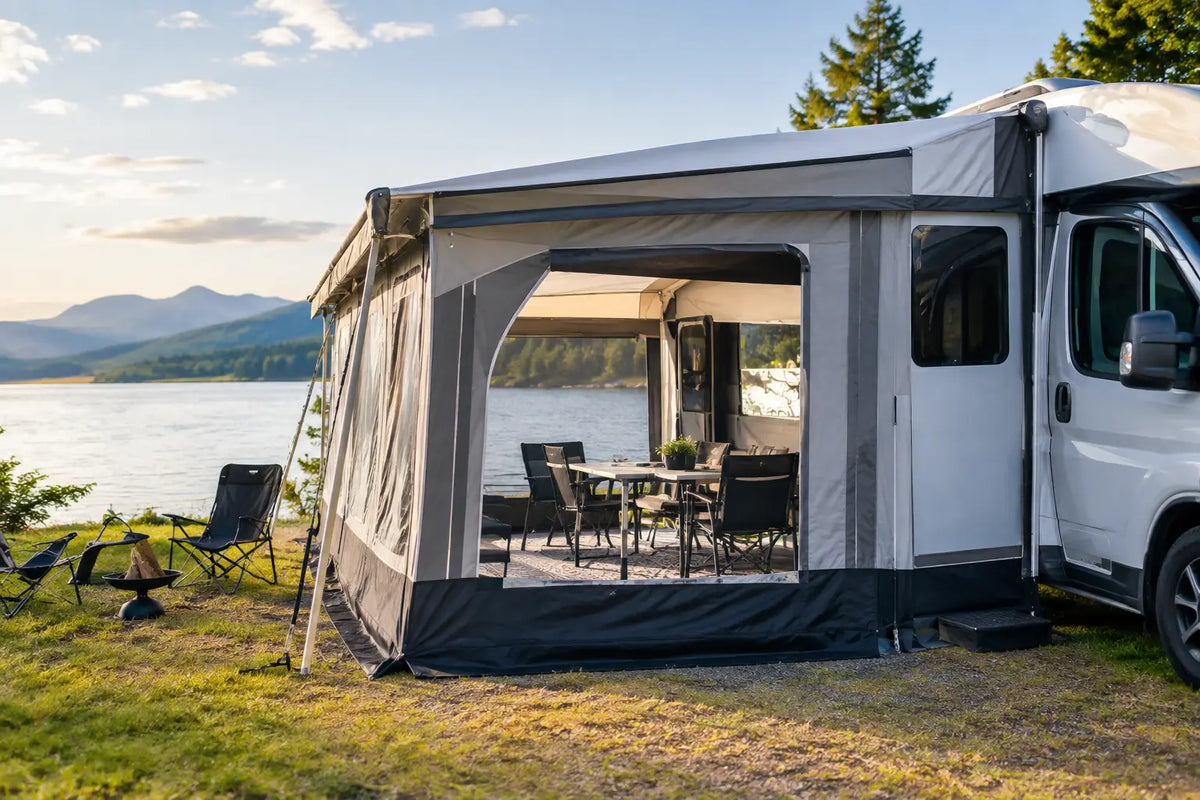
A wet pair of boots, a muddy dog and a pan on the stove can make a compact campsite feel very small, very quickly. Awning rooms change that. By enclosing the sheltered space beneath your vehicle awning, they create a proper outdoor room: somewhere to cook, eat, change, store kit or wait out a passing shower without retreating to the car.
For UK road trips, that extra covered square footage is not a luxury reserved for long expeditions. It is the difference between packing up early because the weather has turned and staying put in comfort. Less campsite compromise. More freedom to follow the road.
What are awning rooms?
An awning room is a set of fabric walls, usually with windows, doors and ground-level fixing points, designed to attach to a compatible vehicle awning. The awning forms the roof; the room enclosure adds privacy and protection around the sides.
The result sits somewhere between a tarp and a ground tent. It is not your sleeping space if you have a rooftop tent, and that is exactly the point. Your vehicle becomes a more complete base camp, with separate zones for sleeping, living and storing the bits that would otherwise clutter the boot.
A good room should feel quick to deploy rather than like another tent to wrestle with. It should zip or slide neatly into the awning, tension securely and pack down without consuming the whole vehicle. When Friday evening traffic has already stolen half your getaway, a complicated setup is not character-building. It is just annoying.
Why an awning room earns its place
The obvious benefit is weather protection. Britain does not always deliver rain in a dramatic downpour. More often, it offers persistent drizzle, gusty wind and damp ground that slowly gets into everything. An enclosed awning gives you a dry place to make dinner, pull on a jacket or sit with a brew while the weather does its thing.
It also gives a small vehicle a much bigger footprint. A couple can use the space as a relaxed dining area. Families can keep pushchairs, bikes, games and wet layers out of the sleeping area. Friends travelling together can create a communal hub without everyone crowding into one vehicle.
There is a quieter advantage too: organisation. Vehicle camping is brilliant until every item has to be moved three times to find the one thing you need. A room gives chairs, cooking equipment, food crates and footwear a designated place. Pack less chaos into your weekend, and the whole trip feels more considered.
That does not mean an enclosed room is essential for every overnight stop. For a quick fair-weather stop on the coast, an open awning may be all you need. Rooms come into their own when the forecast is mixed, the trip runs for several nights, or you want your camp to remain comfortable after dark.
Choosing awning rooms that fit your setup
Compatibility comes first. Awning rooms are not universal simply because they look similar. Check the awning’s length, height, mounting style and attachment system before choosing an enclosure. A room that does not match the awning properly can leave gaps, sag in rain or create unnecessary strain at the fixing points.
Match the room to how you travel
Start with the question that matters: what do you need the space to do? If you mostly travel as a pair, a compact side room may be ideal for cooking and wet-weather seating. If you travel with children or spend weeks on the road, a larger enclosure with generous headroom and multiple access points will be far more useful.
Think about where your vehicle will be parked too. Low woodland pitches, exposed coastal sites and busy campsites each place different demands on an awning room. More windows bring light and views, but they can also reduce privacy. Solid panels feel more protected in wind and rain, but can make a compact pitch feel enclosed. The best choice is rarely the biggest option. It is the one that suits the way you actually camp.
Look beyond the fabric
Fabric quality matters, but it is not the full story. Look for reinforced stress points, dependable zips, secure pegging loops and seams designed to cope with repeated use. Windows should be easy to cover when privacy or poor weather calls for it, while ventilation should stop the room becoming stuffy when you are cooking or drying damp kit.
A strong waterproof rating is reassuring, yet real-world weather performance also depends on setup. Water needs a clear route off the roof. Panels need to be tensioned so they do not flap or collect rain. Pegs and guy lines need to suit the ground beneath you. Premium equipment gives you confidence, but a thoughtful pitch makes it perform as intended.
Consider the pack-down reality
The glamorous part is arriving at a quiet pitch with the door open to a view. The practical part is packing away after rain, sand or a long weekend. Choose a room that can be cleaned easily, folded without a fight and stored in a bag that fits your vehicle plan.
If you regularly move campsites, fast setup and pack-down should sit high on your list. If you tend to stay in one place for several nights, you may happily accept more panels and a more substantial footprint in return for greater comfort. There is no wrong answer, only the right trade-off for your travel style.
How to set up an awning room well
Choose your pitch with the room in mind, not just the rooftop tent. Leave enough space on the awning side for doors to open and guy lines to run safely. Avoid pooling water, and try to angle the vehicle so rain will naturally shed away from your living area rather than towards it.
Attach the room before fully tensioning every point, then work around the perimeter gradually. This helps the panels sit square and reduces strain on the zips. Secure the corners first, add the remaining pegs, then adjust the guy lines until the fabric is taut without being overstretched.
In wind, lower the awning if your system allows and use every recommended tie-down point. Never treat an enclosed awning room like a permanent structure. Conditions can change quickly, especially on open ground, and packing it away early is always smarter than testing its limits.
Inside, keep the entrance clear and establish simple zones. Put wet footwear near the door, cooking equipment where ventilation is best and seating away from the most likely drip line. A compact lantern, a ground mat and a few stackable crates can make the room feel less like a temporary shelter and more like a usable extension of camp.
Awning rooms and rooftop tents: a better camp layout
A rooftop tent gets you off the ground, speeds up bedtime and keeps your sleeping area separate from the dirt of the day. Add an awning room, and the vehicle starts to work as a complete camping system.
Up top, you have a dry, elevated place to sleep. Below, you have a protected area for everything that happens before and after bed: dinner, card games, packing, changing clothes and watching the rain fade across the windscreen. It is a simple layout, but it makes spontaneous travel feel far less improvised.
That is the appeal of a well-designed setup from Urban Caveman. It is not about carrying more gear for the sake of it. It is about choosing equipment that removes friction, so leaving the city can be a decision made on Thursday night rather than a project that takes weeks to plan.
Make room for the trips you actually want
Awning rooms will not make every forecast sunny, and they cannot turn a cramped campsite into a private estate. They can, however, give your vehicle the living space that makes more trips viable. Choose the right fit, pitch it with care, and a rainy lay-by, a woodland campsite or a distant coastal pitch becomes somewhere you are happy to stay a little longer.
Share:
Premium Roof Tent Durability Review for UK Roads
Are Roof Tents Noisy? What You’ll Hear at Night