

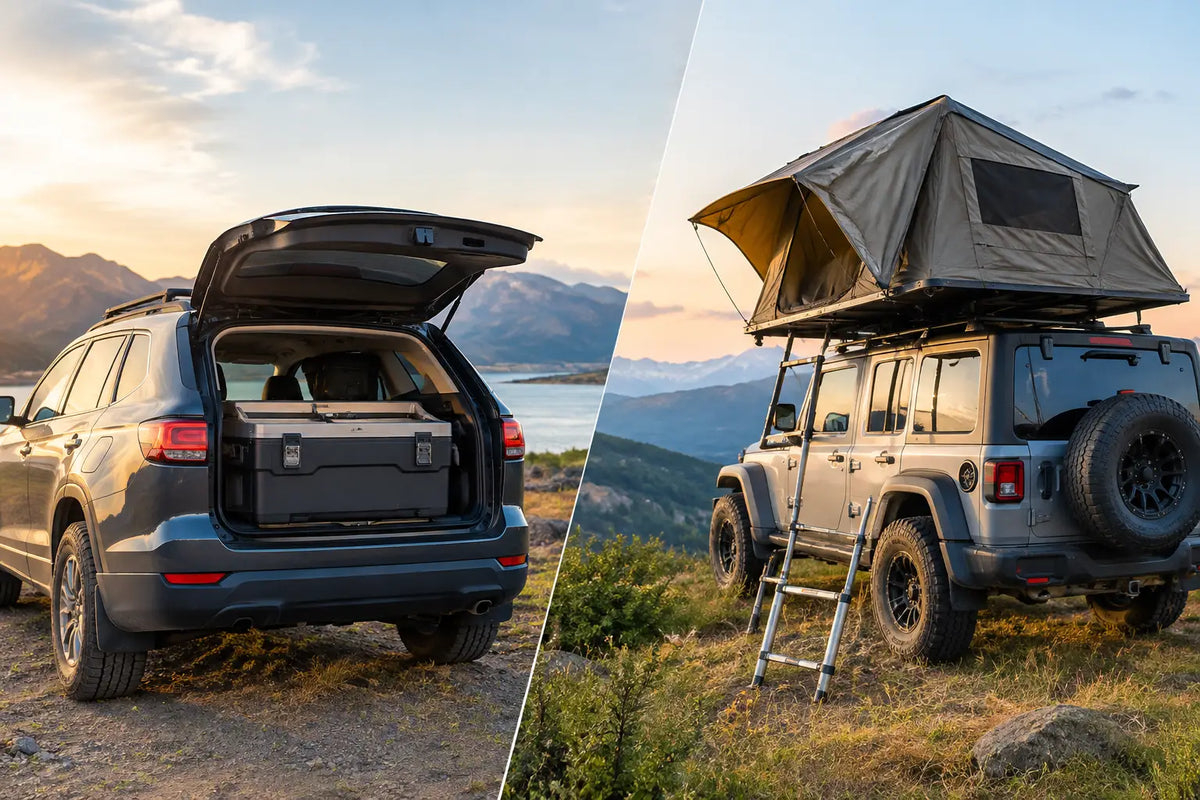
A Friday escape should not begin with forty minutes of wrestling poles, hunting for a level patch of grass and discovering the rain has arrived before the tent is up. The camping box versus roof tent decision comes down to a simpler question: do you want to sleep inside your vehicle, or above it?
Both can turn a standard car, SUV or 4x4 into a capable basecamp. Both remove much of the faff from traditional ground camping. But they create very different trips - from how you pack on Thursday evening to how you wake up beside a wet Welsh lake on Saturday morning.
For drivers who want more comfort, faster setup and room to go further, the right choice is less about following a trend and more about how you actually travel.
Camping box versus roof tent: the key difference
A camping box is a modular unit that sits in the boot or rear of your vehicle. It commonly combines a slide-out kitchen, storage drawers and, in some setups, a platform that lets you sleep inside the car. It is tidy, self-contained and particularly appealing for solo travellers, compact vans and estates with enough interior length.
A roof tent mounts to roof bars or a roof rack and unfolds into an elevated sleeping space. Most designs include an integrated mattress, while hard-shell models open in moments. Your vehicle cabin stays free for kit, passengers and the small luxuries that make a rainy weekend feel like a break rather than a test of character.
Neither is automatically better. A camping box makes sense when discreet parking, low overall vehicle height and an indoor cooking setup matter most. A roof tent earns its place when you want a proper bed, clear separation between living and sleeping space, and a campsite setup that works just as well for a one-night stop as a longer overland route.
Start with the way you use your vehicle
The most practical purchase is one that fits your ordinary week as well as your wild weekends. If your vehicle is a daily driver that regularly carries children, dogs, sports kit or work equipment, consider what stays where once the camping system is installed.
A camping box occupies boot space permanently unless you lift it out between trips. For some drivers, that is no issue. For others, it means the weekly shop, buggy or climbing gear suddenly needs a new home. Sleeping in the vehicle can also require folding rear seats flat and moving bags outside or into the front seats at bedtime.
A roof tent leaves the cabin available. You can keep recovery gear, cooking equipment, chairs and clothing organised below, then climb into a dedicated sleeping area at night. The trade-off is roof weight and added height. You will need compatible roof bars or a rack, an awareness of low car parks, and a quick check of your vehicle's dynamic and static roof load limits.
For couples taking frequent weekend breaks, a roof tent often creates the cleaner division of space. For one person travelling light in an estate, a camping box may deliver all the simplicity required.
Sleep quality changes the whole trip
There is a major difference between being able to sleep in a car and looking forward to going to bed. A camping box setup can be cosy and protected from the weather, but interior dimensions set the rules. If you are tall, broad-shouldered, travelling as a pair, or simply dislike sleeping among your luggage, those limits become obvious quickly.
A roof tent is built around sleep first. You get a flat, elevated platform, a fitted mattress and enough room to leave bedding in place in many hard-shell designs. The sensation matters too. You are not folded into the rear of your vehicle. You have a separate room, a view through the windows and a quieter buffer from damp ground, mud and passing campsite traffic.
Elevation is not a magical answer to every condition. Strong winds can make any tent noisier, and getting up a ladder may not suit everyone. But for most vehicle campers, especially couples, a proper sleeping platform is the difference between one acceptable night and a routine they want to repeat.
Weather is where convenience becomes confidence
British weather rarely delivers a clean forecast. A warm evening can turn into rain before breakfast, and a coastal pitch can feel completely different after the wind changes direction.
A camping box protects you inside the vehicle, which is reassuring in sustained rain. Yet it can feel close inside when windows must stay mostly shut, and condensation needs managing with sensible ventilation. Cooking inside a vehicle also demands care, airflow and a setup designed for it. Never treat a closed car as a substitute for a proper sheltered camp kitchen.
A quality roof tent gives you an elevated, weather-ready sleeping zone while keeping wet boots, jackets and cooking gear below. Add an awning or tent extension and the vehicle becomes a more complete camp: somewhere to prepare food, change out of damp layers and wait out a shower without retreating to the front seats. This is where a roof tent setup starts to feel less like camping equipment and more like mobile freedom.
Setup speed is not just about minutes
Camping boxes are quick because much of the system is already in place. Pull up, open the boot, slide out the kitchen and you are close to settled. If you sleep inside, though, the evening routine can include rearranging seats, bags and bedding. Leaving early may mean reversing all of that before you can drive away.
A hard-shell roof tent has a different kind of speed. Park, release the catches, open the shell and climb in. There is very little assembly, and bedding can usually remain inside. The boot stays packed exactly as you need it. For late arrivals, overnight ferry stops or spontaneous detours off a road trip, that consistency is valuable.
Soft-shell roof tents can offer more floor space for the money, but generally take longer to deploy and pack away. They suit travellers happy to trade a few extra minutes for a larger sleeping footprint. Hard-shell designs favour drivers who value clean lines, rapid setup and a lower-friction escape from the city.
Consider access, campsites and everyday driving
A camping box has a clear advantage for stealthier overnight stops where legal and appropriate: from the outside, the vehicle remains close to its normal profile. It is also easier to use in height-restricted car parks and less affected by crosswinds on exposed motorways.
Roof tents are best used on suitable, permitted pitches and places where you can safely deploy the ladder. They add height, can affect fuel economy, and require you to think before entering a multi-storey car park or a barrier-controlled beach car park. These are manageable compromises, not deal-breakers, but they should be part of the decision before purchase.
Families should also think about access. Young children may love the novelty of a roof tent, but an adult needs to be comfortable supervising ladder use. Some families solve this with a roof tent for adults and a ground tent or vehicle sleeping arrangement for older children. Others choose a larger roof tent and keep the setup deliberately simple.
Cost, capacity and the gear you already own
A camping box can be a cost-effective starting point, especially if you already own a suitable sleeping mat, stove and window ventilation kit. It also makes a strong case for people who mostly take short solo trips and want an organised boot rather than a full rooftop camp.
A roof tent asks for a larger initial investment, plus roof bars or a rack if you do not already have them. In return, it gives you a dedicated bedroom without sacrificing the vehicle interior. The value becomes clearer with regular use: more comfortable nights, easier packing and a setup that makes last-minute trips feel realistic rather than ambitious.
Do not judge capacity by advertised berth numbers alone. Think about how you sleep, how much bedding you use and whether you need room for a child or dog. Measure your vehicle roof, check weight limits carefully, and account for accessories such as an awning, crossbars or storage cases before committing.
When a camping box is the better call
Choose a camping box if you want a discreet, low-profile solution and usually travel alone or with minimal gear. It is well suited to vehicles with a long, flat load area, drivers who need to use low car parks, and anyone whose trips centre on simple overnight stops rather than a spacious campsite base.
It also works brilliantly as part of a broader setup. A well-designed box can organise food, water and cooking equipment even if you sleep in a separate ground tent. For certain vehicles and travel styles, that modularity is exactly the point.
When a roof tent is worth it
Choose a roof tent if your priority is a comfortable bed that is ready wherever you park. It is the stronger fit for couples, frequent weekend travellers and anyone who wants their car interior available for life below deck.
It is also the more natural choice when your trips stretch beyond one night. With a roof tent above and shelter beside the vehicle, you can create a camp that handles breakfast in drizzle, muddy boots after a walk and the need for a little personal space. Urban Caveman roof tents are built around that idea: less setup, more comfort, and a basecamp ready for life beyond the city.
The best setup is the one that makes you leave more often. Choose the system that suits your vehicle, your passengers and the kind of morning you want to wake up to - then keep a bag packed and let the next clear gap in the diary take care of the rest.
Share:
Top Tent Extension Features Worth Packing
Do Rooftop Tents Leak? What Rain Reveals