

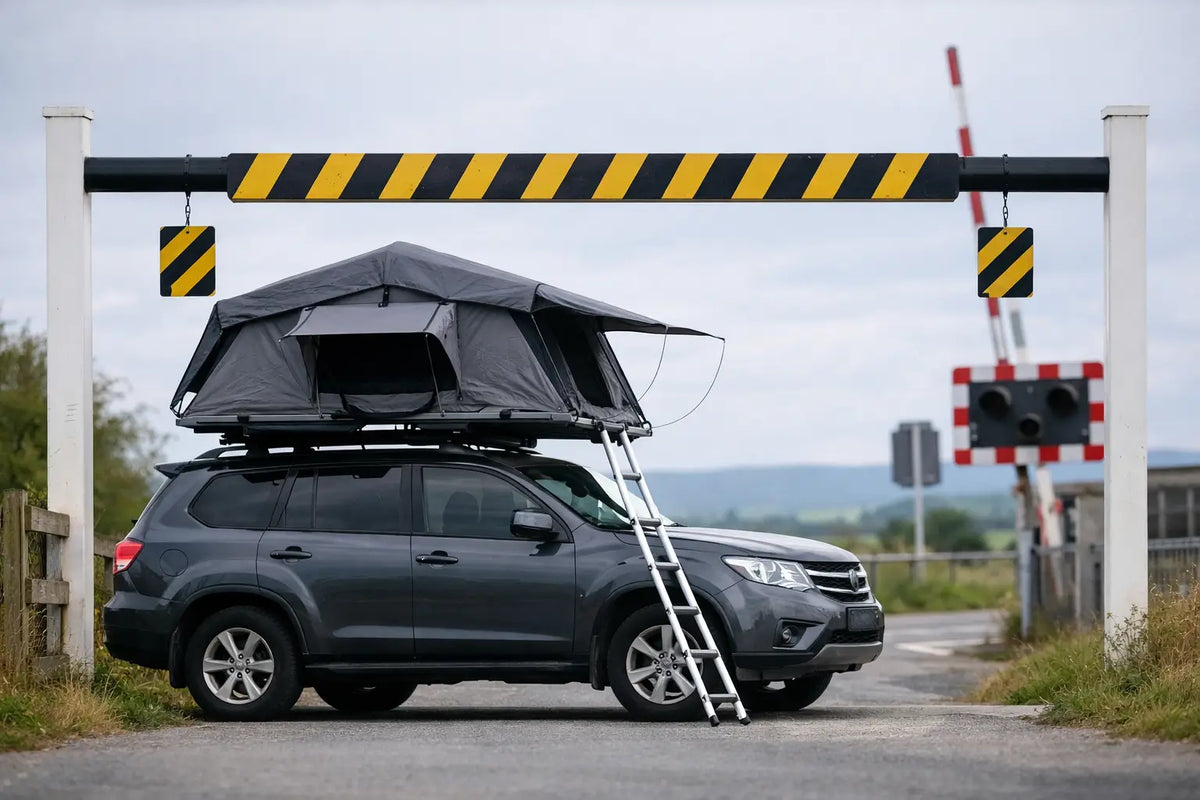
A rooftop tent changes the shape of your vehicle before it changes your weekend. That extra height can turn a Friday-night escape into a comfortable elevated campsite in minutes - but only if you know where the roofline will catch you out. For anyone researching rooftop tent height restrictions UK, the reassuring answer is that there is no single national maximum height specifically for rooftop tents. The practical answer is more useful: your vehicle still has to fit safely under every bridge, barrier, canopy and campsite entrance on the route.
This is less about paperwork and more about preparation. Measure once, display the figure where you can see it, and the road out of the city stays open.
Are there UK height restrictions for rooftop tents?
A rooftop tent does not create a separate vehicle class, and UK law does not set a dedicated height limit simply because you sleep on the roof. Most cars, SUVs, vans and pickups fitted with a folded rooftop tent remain comfortably below the general maximum vehicle height used on UK roads.
The restriction you will meet is the one in front of you. Low bridges, multi-storey car parks, drive-throughs, covered forecourts, height barriers and ferry decks all have their own clearance limits. A sign showing a maximum headroom is not a suggestion or an estimate. If your loaded height exceeds it, choose another route.
There is also a crucial difference between travelling and camping. When the tent is folded down and secured, its closed height is the figure that matters on the road. When it is open, it may extend well above the vehicle, but you should only deploy it on a suitable pitch with enough overhead space. Never open a tent beneath branches, cables, canopies or a campsite shelter.
Your real rooftop tent height: measure the loaded vehicle
Manufacturer dimensions are a starting point, not your final answer. Roof bars, mounting brackets, crossbars, suspension changes, tyre size and the tent itself all affect the finished height. Even two apparently identical vehicles can sit differently once equipped.
Measure your vehicle on level ground with the rooftop tent fully closed, latched and ready to travel. Use a long tape measure from the ground to the highest fixed point. That may be the tent shell, a roof box mounted alongside it, a solar panel, or a raised accessory bracket.
Do not rely on the height stated in your vehicle handbook. That figure describes the standard vehicle, not your adventure-ready setup. A folded hard-shell tent can add a relatively slim profile, while some soft-shell designs and tall roof-bar systems add more. The exact result depends on your vehicle and mounting arrangement.
Write the final figure down in metres and feet, then put it somewhere visible from the driver’s seat. A small label on the sun visor is enough. When a low bridge appears after three hours of motorway driving and one questionable sat-nav diversion, you should not be doing mental arithmetic.
Give yourself a sensible margin, too. A marked clearance is not an invitation to pass through with millimetres to spare. Road surfaces can be uneven, ramps can raise the vehicle angle, and signs may refer to the lowest point across the full width of the entrance. If the gap looks close, it is close.
Where rooftop tent height catches drivers out
Low railway bridges are the obvious concern, particularly on rural roads and through older towns. Their signed clearances must be respected, and route planning matters if your vehicle sits higher than a typical family car. A collision with a bridge can cause serious damage, road closures and danger to other people.
Yet the more common frustrations tend to be everyday places. Multi-storey car parks frequently have low limits, sometimes below 2 metres. A rooftop tent may rule them out altogether. Many supermarket and leisure car parks also use height barriers to limit access, while drive-through restaurants, hotel porte-cochères and covered fuel-station areas can be surprisingly tight.
Campsites deserve the same attention. The track to a remote pitch might pass beneath mature trees or through a low entrance arch. Some sites use barriers that are lower than their advertised vehicle access allows, and wooded pitches can be brilliant for shade until the tent lid meets a branch. Check the access route before committing to a narrow lane.
Ferries and the Channel Tunnel are different again. You can travel with a rooftop tent, but declare your vehicle’s correct height when booking. Operators use this information to allocate space and loading arrangements. Booking as a standard-height car when your tent takes you into a taller category can create delays at check-in and may mean an additional charge.
Plan routes for the vehicle you actually drive
Navigation apps are excellent until they are not. Many default car routes do not account for a roof-mounted load, and a route that works for an unmodified hatchback may lead a tent-equipped vehicle towards a low structure. Before a new trip, compare your measured height with the roads, crossings and car parks you expect to use.
For longer journeys, especially through unfamiliar rural areas, use route planning that allows vehicle dimensions to be considered. Keep an alternative in mind when a bridge or barrier creates doubt. Turning around on a single-track lane is not the kind of off-grid freedom anyone is chasing.
This applies just as much on the way home. A campsite arrival is usually planned. The final stop for food, a shower at a leisure centre, or overnight parking near a trailhead is where height assumptions often slip in.
Campsites, overnight stops and tent-open height
Height restrictions are only one part of sleeping responsibly in a rooftop tent. Campsites may set their own rules on vehicle size, pitch placement, opening times and whether rooftop tents are permitted on certain pitches. A tent that opens over the side of the vehicle needs enough clear ground for its ladder and enough space from neighbouring units.
On sloping pitches, level the vehicle before opening the tent. This improves comfort and helps the ladder sit securely, but it can also alter the effective height at one side. Check that the open shell, fabric and ladder are clear of branches and site infrastructure before you climb up.
If you are considering an informal overnight stop, do not assume the tent makes parking acceptable. Rules on parking, camping and overnight stays vary by landowner, local authority and location. Height barriers are often a clear signal that overnight vehicle use is not welcomed there. Choose permitted campsites or places where you have explicit permission instead.
Do not forget the load and mounting limits
A lower-profile tent can make clearance simpler, but height should never be the only buying decision. Your vehicle’s dynamic roof load limit - the maximum permitted while driving - must support the combined weight of the tent, bars and any roof-mounted accessories. The roof bars and mounting system must also be compatible with both the vehicle and tent.
Static capacity is usually much higher than dynamic capacity, which is why a correctly fitted rooftop tent can support occupants when parked. They are not interchangeable figures. Follow the vehicle manufacturer’s guidance and the tent manufacturer’s fitting instructions, and use a professional installer if there is any uncertainty.
Before every journey, check that the tent is fully folded, its cover or shell is properly secured, and all straps and latches are in place. A tent that is safe at motorway speed is one that has been mounted correctly, loaded within limits and inspected before setting off.
A quick pre-departure height check
Before leaving, confirm your closed vehicle height, check your first and final destinations for barriers, and make sure your booking reflects the vehicle dimensions. On arrival, look up before you unfold. It takes less time than repairing a shell, replacing a branch-damaged cover, or explaining why you are reversing out of a car park queue.
Urban Caveman equipment is built for life beyond the city, not for complicated rituals before you reach it. Get the dimensions right, treat clearance signs seriously, and your rooftop tent becomes what it should be: a fast, comfortable basecamp wherever the road takes you.
The best trips leave room for detours. Just make sure your roofline does too.
Share:
Rooftop Tent Effect on Fuel Economy Explained
Rooftop Tent Insurance in UK: What to Check